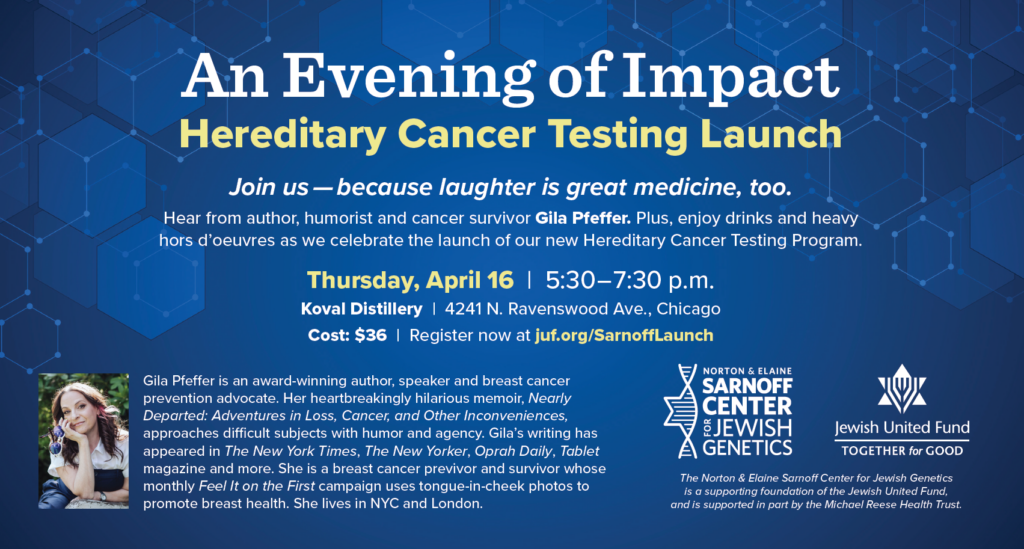
Our testing panel tests for 63 genes that can predispose to hereditary cancer syndromes, 4 of which are more common in the Ashkenazi Jewish population. You can learn more about each gene on the panel by browsing or searching the database below. If you have any questions, you can learn more about our hereditary cancer testing program or contact us at [email protected] or 312-357-4718 to speak to a genetic counselor.
Pathogenic variants (disease-causing) in the APC gene cause familial adenomatous polyposis (FAP) and attenuated FAP, conditions marked
Pathogenic variants (disease-causing) in the ATM gene are linked to a moderate increase in cancer risk, most notably
Pathogenic variants (disease-causing) in the AXIN2 gene are associated with an increased risk of colorectal cancer and
Pathogenic variants (disease-causing) in the BAP1 gene are associated with BAP1 tumor predisposition syndrome, which increases the risk
Pathogenic variants (disease-causing) in the BARD1 gene are associated with an increased risk of breast cancer, particularly
Pathogenic variants (disease-causing) in the BLM gene may increase the risk for colon cancer, but additional data
The BMPR1A gene is associated with juvenile polyposis syndrome (JPS) which increase risks for gastrointestinal polyps, colorectal
Pathogenic variants (disease-causing) in the BRCA1 gene can predispose individuals to develop cancer. For women, there is
Pathogenic variants (disease-causing) in the BRCA2 gene can predispose individuals to develop cancer. For women, there is an
Pathogenic variants (disease-causing) in the BRIP1 gene are associated with an increased risk of ovarian cancer. There may
Pathogenic variants (disease-causing) in the CDH1 gene are associated with Hereditary Diffuse Gastric and Lobular Breast Cancer
Pathogenic variants (disease-causing) in the CDK4 gene are associated with a significantly increased risk of cutaneous (skin)
Pathogenic variants (disease-causing) in the CDKN2A gene (also known as p16) can affect two different proteins in
Pathogenic variants (disease-causing) in the CHEK2 gene are associated with a moderate increase in cancer risk, most
Pathogenic variants (disease-causing) in the CTNNA1 gene are associated with Hereditary Diffuse Gastric Cancer (HDGC) syndrome, similar
Pathogenic variants (disease-causing) in the DICER1 gene are associated with DICER1 tumor predisposition syndrome. This condition increases
Pathogenic variants (disease-causing) in the EGFR gene been reported in association with familial lung cancer predisposition, but
Pathogenic variants (disease-causing) called deletions at the end of the EPCAM gene cause Lynch syndrome (previously known as
Pathogenic variants (disease-causing) in the FH gene are associated with Hereditary Leiomyomatosis and Renal Cell Cancer (HLRCC) syndrome.
Pathogenic variants (disease-causing) in the FLCN gene are associated with Birt–Hogg–Dubé syndrome. This condition predisposes individuals to fibrofolliculomas
Pathogenic variants (disease-causing) in the GALNT12 gene have been implicated in an increased risk of colorectal cancer.
Pathogenic variants (disease-causing) in the GREM1 gene cause Hereditary Mixed Polyposis Syndrome (HMPS), which is characterized by
Pathogenic variants (disease-causing) in the HOXB13 gene are linked to an increased risk of prostate cancer. There
Pathogenic variants (disease-causing) in the KIT gene cause primary familial gastrointestinal stromal tumors (GIST) which is associated
Pathogenic variants (disease-causing) in the MAX gene can predispose individuals to tumors such as paragangliomas (head and
Pathogenic variants (disease-causing) in both copies of the MBD4 gene cause MBD4-Associated Neoplasia Syndrome (MANS). MANS is
Pathogenic variants (disease-causing) in the gene MEN1 causes Multiple Endocrine Neoplasia type 1 (MEN1), a syndrome in
Pathogenic variants (disease-causing) the MET gene causes Hereditary Papillary Renal Cancer (HPRC), a condition that raises the
Pathogenic variants (disease-causing) in the MITF gene are associated with an increased lifetime risk of melanoma (skin
Pathogenic variants (disease-causing) in MLH1 gene cause Lynch syndrome (previously known as hereditary non-polyposis colorectal cancer (HNPCC)). People
Pathogenic variants (disease-causing) in both copies of the MLH3 gene have MLH3-associated polyposis syndrome, which is associated
Pathogenic variants (disease-causing) in the MSH2 gene cause Lynch syndrome (previously known as hereditary non-polyposis colorectal cancer (HNPCC)).
Pathogenic variants (disease-causing) in both copies of the MSH3 gene have MSH3-associated polyposis syndrome, which is associated
Pathogenic variants (disease-causing) in the MSH6 gene cause Lynch syndrome (previously known as hereditary non-polyposis colorectal cancer (HNPCC)).
Pathogenic variants (disease-causing) in both copies of the MUTYH gene cause MUTYH-associated polyposis (MAP), a recessive condition
Pathogenic variants (disease-causing) in the NF1 gene cause neurofibromatosis type 1, a multisystem condition marked by multiple
Pathogenic variants (disease-causing) in both copies of the NTHL1 gene cause NTHL1 tumor syndrome, a rare autosomal recessive
Pathogenic variants (disease-causing) in the PALB2 gene increase the lifetime risk for several cancers, most notably breast cancer.
Pathogenic variants (disease-causing) in the PDGFRA gene can increase the risk of developing gastrointestinal stromal tumors (GISTs), a
Pathogenic variants (disease-causing) in the PMS2 gene cause Lynch syndrome (previously known as hereditary non-polyposis colorectal cancer (HNPCC)).
Pathogenic variants in POLD1 cause polymerase-proofreading–associated polyposis (PPAP), a hereditary cancer predisposition syndrome characterized by an increased
Pathogenic variants in POLE cause polymerase-proofreading–associated polyposis (PPAP), a hereditary cancer predisposition syndrome characterized by an increased risk
PTEN is a tumor-suppressor gene involved in regulating cell growth, and pathogenic variants (disease-causing) cause PTEN hamartoma
The RAD51C is a gene involved in the repair of DNA damage, and pathogenic variants (disease-causing) increase the
The RAD51D is a gene involved in the repair of DNA damage, and pathogenic variants (disease-causing) increase
RB1 is a tumor-suppressor gene and individuals who inherit a pathogenic variant (disease-causing) in RB1 are at
Pathogenic variants (disease-causing) in the RET gene cause multiple endocrine neoplasia type 2 (MEN2), a hereditary cancer
RNF43 is a tumor-suppressor gene and pathogenic variants (disease-causing) are associated with an increased risk for serrated
The RPS20 gene has been associated with a predisposition to colorectal cancer, typically presenting as early-onset disease
Pathogenic variants (disease-causing) in the SDHA gene can predispose individuals to tumors such as paragangliomas (head and neck
Pathogenic variants (disease-causing) in the SDHAF2 gene can predispose individuals to tumors such as paragangliomas (head and
Pathogenic variants (disease-causing) in the SDHB gene can predispose individuals to tumors such as paragangliomas (head and neck
Pathogenic variants (disease-causing) in the SDHC gene can predispose individuals to tumors such as paragangliomas (head and
Pathogenic variants (disease-causing) in the SDHD gene can predispose individuals to tumors such as paragangliomas (head and neck
The SMAD4 gene is associated with juvenile polyposis syndrome (JPS) which increase risks for gastrointestinal polyps, colorectal
The SMARCA4 gene is associated with SMARCA4-related tumor predisposition syndrome, most notably increasing the risk for small
The STK11 gene is associated with Peutz-Jeghers syndrome (PJS), an autosomal dominant condition that causes distinctive dark
The TERT gene can lead to telomere biology disorders, which form a spectrum ranging from mild adult-onset disease
Pathogenic variants (disease-causing) in the TMEM127 gene can predispose individuals to pheochromocytomas (adrenal gland tumor) and less
The TP53 gene is associated with Li-Fraumeni syndrome (LFS), a hereditary cancer predisposition characterized by very high
The TSC1 gene is one of the two major genes associated with tuberous sclerosis complex (TSC), a
The TSC2 gene is one of the two major genes associated with tuberous sclerosis complex (TSC), a
The VHL gene is associated with von Hippel–Lindau (VHL) syndrome, an inherited condition that increases the risk of